
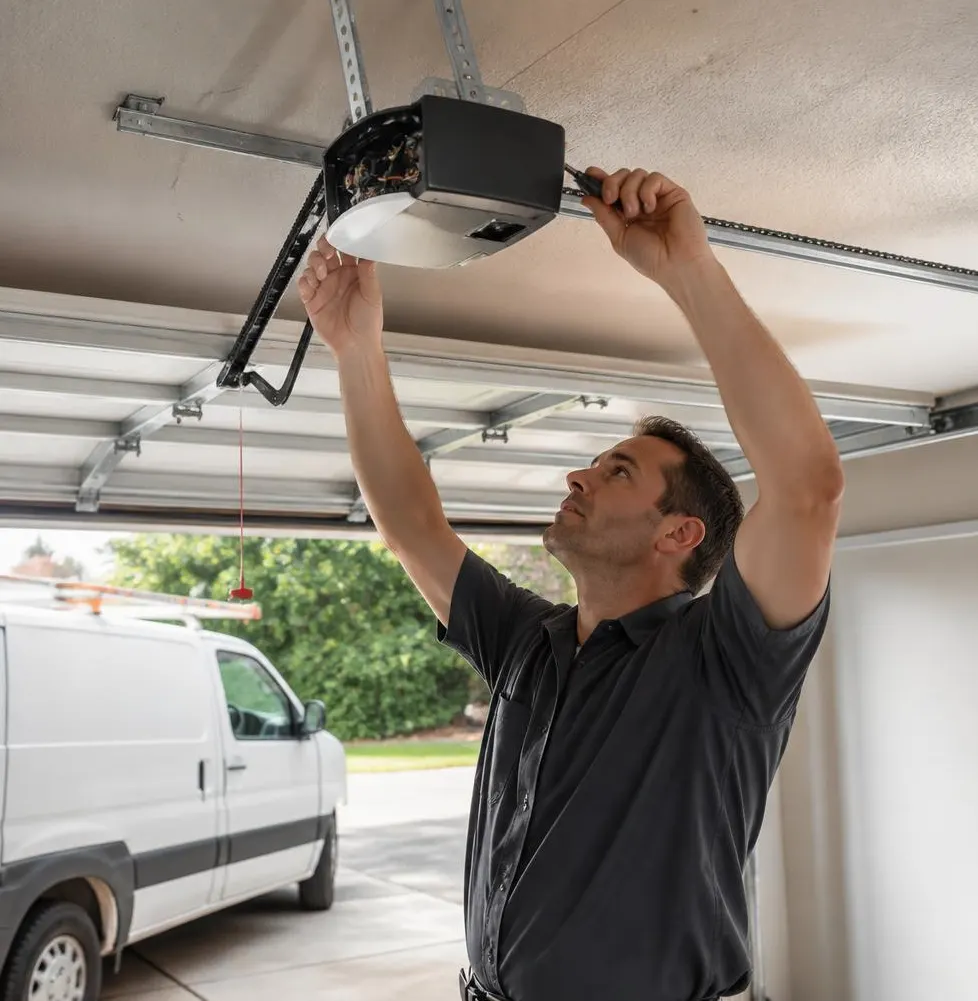
What a Technician Sees on a Typical Spring Call
Most spring calls start the same way: the door worked fine yesterday, and today it either won't budge, slammed down hard, or made a bang like a gunshot from the garage. By the time a technician gets there, the spring is usually already broken. The frustrating part is that almost every one of these calls had warning signs for weeks, sometimes months, before the actual snap. A gap in the coils. A door that felt a little heavier each time you lifted it by hand. A squeal the opener didn't used to make. Homeowners rarely clock these as spring problems because the door still opens and closes until the moment it doesn't.
Torsion springs (mounted on a bar above the door) and extension springs (stretched along the horizontal tracks) wear differently, but both telegraph their fatigue if you know where to look. Walk through this checklist in your own garage, with the opener disconnected and the door closed, before you're the one calling about a door stuck halfway open.
The Walkthrough
- Gaps between torsion spring coils. With the door fully closed, look at the coils on the torsion spring above the door. If you see noticeable daylight between coils rather than them sitting tight against each other, the spring has lost tension. This means it's no longer carrying its full share of the door's weight, and the opener or your arms are compensating.
- Rust, pitting, or discoloration on the coils. Coastal salt air works on exposed metal faster than people expect, even in a closed garage, especially if the door faces the street or gets airflow from an open window nearby. Surface rust on a spring is a structural weak point: it thins the wire and makes a sudden break more likely under normal tension, not just old age.
- The door feels heavier than it used to. Disconnect the opener (pull the red release cord) and lift the door by hand. It should move smoothly and feel roughly balanced, not like dead weight. A door that's noticeably harder to lift than it was a year ago is losing spring assistance.
- The door won't hold its position halfway up. With the opener disconnected, raise the door about waist height and let go. A healthy spring system holds the door roughly in place. If it drifts down or drops, the spring is under-tensioned and the whole system, including the cables and the opener's gearing, is working harder than it should.
- Loud bangs, pops, or creaks during operation. A spring that's close to failing often makes noise before it gives out, a sharp creak as it flexes or a pop as a coil shifts. This is different from the dry squeak of an ungreased hinge; it's a mechanical complaint from the spring itself.
- The opener strains, slows down, or grinds. If the motor sounds like it's working harder than it used to, or the door opens noticeably slower, the opener is compensating for a spring that isn't doing its job. This also shortens the opener's lifespan, so an aging spring can turn into a bigger repair bill than it needed to.
- Frayed, loose, or kinked cables on extension spring setups. On doors with extension springs, check the lift cables running alongside the tracks. Fraying or slack cable is often a direct sign the spring it's paired with has stretched past its working range.
- Visible stretching or uneven length on extension springs. Compare both springs side by side. If one looks noticeably longer or more elongated than the other, it's wearing out faster, which also throws off how evenly the door travels.
- The door rises or closes unevenly, favoring one side. Torsion systems usually use two springs, one per side. If one is weaker, the door can jerk, tilt, or bind in the tracks as it moves. This also puts uneven stress on rollers and hinges over time.
Keep in mind that structural shifts from earthquake retrofit work, foundation settling, or even a hard slam from wind can throw off door balance independent of spring age. If your door suddenly feels off after any work on the house, it's worth running this checklist even if the springs are relatively new.
When to Call Top Garage Door Santa Monica
If two or more items on this list match what you're seeing, don't wait for the snap. A spring that lets go under tension can cause real injury or damage to the door and track. Our technicians handle Spring Replacement for both torsion and extension systems, matched to your door's weight and cycle rating rather than a generic swap, and we check the opener and cables at the same time since a worn spring often takes a toll on both. If your spring has already broken and the door is stuck, our Emergency Garage Door Service gets a technician out to secure the door safely and get it functioning again.
If you're noticing any of the signs above on your garage door in Santa Monica or anywhere on the Westside, call Top Garage Door Santa Monica for an inspection before a worn spring turns into a stuck door or a bigger repair.